Westcoast Wool & Livestock would like to remind all clients of the upcoming electronic identification (eID) requirements for sheep across Western Australia.
In 2022, federal and state agricultural ministers agreed to introduce a mandatory national eID system to strengthen livestock traceability and improve biosecurity within the Australian livestock industry.
📌 Key things to Remember:
From 1 July 2026 Visual tags alone will no longer be accepted. All sheep, regardless of age, must carry an approved eID before leaving the property.
Additional reminders for producers:
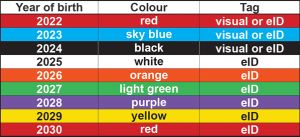
✔ Year-of-birth coloured eID tags remain mandatory in WA
✔ Animals should only carry one active eID at any one time
✔ Replacement tags for purchased stock must be pink post-breeder tags applied in the opposite ear
✔ Only accredited NLIS-approved devices displaying the NLIS logo can be used
✔ Sheep born prior to 1 January 2025 that currently have a visual tag only will not require an eID unless they are moving off-property after 30 June 2026.
Please ensure you are prepared ahead of the upcoming deadlines to avoid disruptions to livestock movements and compliance requirements.
For more information, please contact your Westcoast Wool & Livestock representative or please refer to the Department of Primary Industries and Regional Development (DPIRD).
Tag Colour System
Following this transition, yellow NLIS eIDs can be used to identify stock born prior to 1 January 2025, when moving off their property of birth, after 1 July 2026.
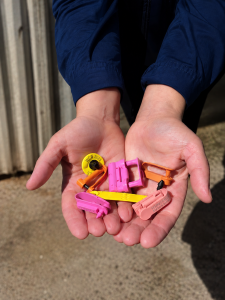
Pink post breeder eIDs will only be necessary if the original breeder NLIS eID is missing or damaged, or if you have stock departing your property from 1 July 2026 onward that did not originate from your property. There can only be one eID on an animal at any time.
Examples of eID tags
In addition to the RFID chip embedded within the eID, which can be read using a handheld scanner or panel reader, all fully accredited NLIS eIDs are printed with the NLIS logo and a unique 16-character identification code.
The 16-character code is made up of:
- The first 8 characters – the PIC (Property Identification Code) the device is registered to.
- The next 3 characters – identify the manufacturer, followed by a breeder tag designation (sheep S or goat K) or post-breeder tag designation (sheep T or goat L), and the year of manufacture (stud year code).
- The final 5 characters – a unique serial number, which can be customised when ordering and may begin with a letter.
Depending on the manufacturer and the type of eID selected, additional information such as your registered brand may also be printed on the tag. See the examples below.
Ear Tag Positioning
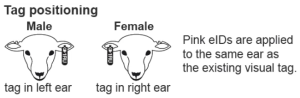
A year-of-birth coloured eID tag must be applied to the ear according to the animal’s sex; left ear for males and right ear for females. This follows the same tagging system used for both visual and electronic identification tags, with pink eIDs being applied to the same ear as the existing visual tag.